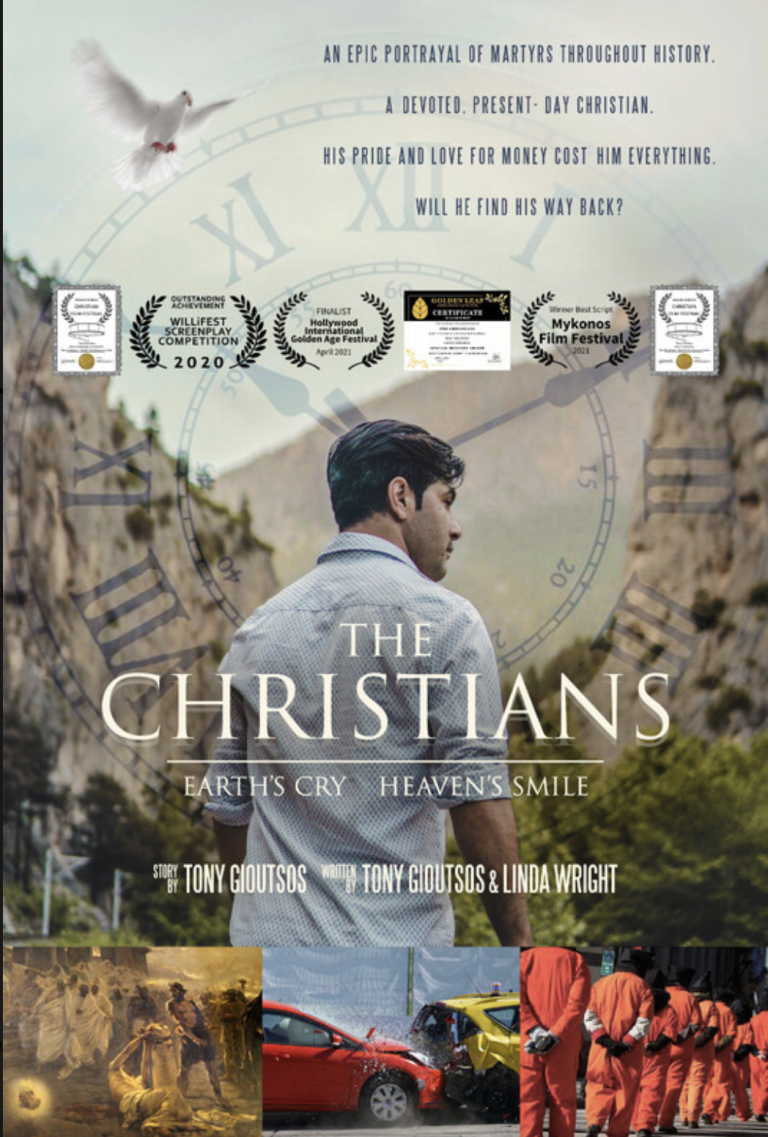
The Christians: Earth’s Cry ~ Heaven’s Smile, winner of the Athens Indie Film Festival, is an ambitious and emotionally charged screenplay by Tony Gioutsos and Linda M. Wright. It unfolds as both a deeply personal coming-of-age narrative and an epic spiritual meditation, blending intimate biography with historical martyrdom in a structure that’s daring, if occasionally overwhelming.
At its center is Christos Giostus, a gifted child of Macedonian-Greek descent growing up in Detroit, whose life is punctuated by visions of Christian martyrs across centuries—from Paul the Apostle to Saint Blandina to the Korean martyr Elizabeth. These visions, presented in richly dramatized dream sequences, aren’t mere historical flashbacks but visceral moral crucibles. They serve as a theological echo chamber for Christos’ own inner transformation, reinforcing the script’s central argument: true change—whether in the world or in oneself—requires a sacrificial and unwavering fidelity to truth, love, and faith.
The script excels in presenting the link between spiritual endurance and scientific innovation. What might seem like a conventional “Christian story” subverts expectations by entering the world of mathematics, information theory, and automotive engineering. Christos’ struggle to design a crash-detection algorithm becomes more than technical—it becomes a metaphorical and even mystical endeavor, one that resonates with divine creation. The repeated refrain of “never lie to yourself” is as much a scientific ethos as it is a spiritual one.
Visually, the recurring motif of the Dove—a symbol of the Holy Spirit—anchors the narrative in a continuous dialogue between heaven and earth. These apparitions are at times comforting, other times ominous, but always signal a larger metaphysical presence watching and guiding, subtly linking martyrdom to purpose, pain to transcendence.
If the screenplay has a weakness, it’s that its moral clarity can occasionally verge on didacticism. Some dialogues, especially during Bible studies or theological debates, risk veering into exposition. Yet, in its best moments, The Christians captures something rare: the collision of spiritual conviction and modern vocation without losing the weight of either.
Ultimately, this is a work that dares to see martyrdom not only in lions’ dens or torture chambers, but in labs, classrooms, and corporate boardrooms. It affirms that the path to grace can run through intellect as much as it does through blood—and that sometimes, the most radical form of faith is simply refusing to compromise the truth.