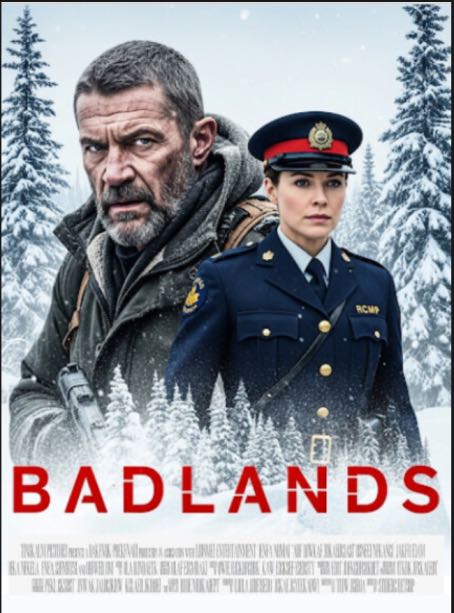
Mark Donnell’s Badlands, winner of Best Script at the January edition of the Santa Barbara International Movie Awards, unfolds like a film carved directly out of ice and wind—a narrative where the landscape is not a setting but a force that shapes, erodes, and ultimately defines human action. From its opening moments, with a plane swallowed by a violent snowstorm in the Alberta wilderness, the screenplay establishes a world governed less by morality than by endurance.
There is a striking confidence in how Donnell writes action on the page. The script is intensely visual, almost tactile, allowing the reader to feel the cold, the pressure, the violence. The crash sequence and its aftermath are particularly effective, not simply as spectacle but as a statement of intent: survival here is provisional, fragile, and always on the verge of collapse. What follows is a narrative driven by a familiar but still potent engine—revenge—yet what gives Badlands its weight is the way this impulse is embedded within a world that offers no redemption, no softness, no possibility of moral recovery.
At the center stands Jack Tyrrell, a figure who feels less like a psychologically evolving character and more like an embodiment of a condition. He is shaped by loss, stripped of illusion, and reduced to a single, unwavering trajectory. The screenplay does not attempt to soften him, and this is both its strength and its limitation. His grief—particularly the loss of his daughter—is rendered with directness and force, but it is not allowed to unfold into ambiguity. Instead, it hardens into purpose. He does not question revenge; he becomes it.
The introduction of Élodie Chenier, the RCMP officer, initially suggests the possibility of tension between law and instinct, between institutional order and personal justice. Yet as the narrative progresses, this tension dissolves rather than deepens. The world of Badlands gradually reveals itself to be structurally corrupt, and in doing so, it collapses the distinction between legality and criminality. What remains is not a conflict between right and wrong, but between those who act and those who hesitate. In this sense, the script moves away from procedural logic and toward something more primal, almost mythic.
Donnell’s dialogue carries a certain rough texture that suits the environment, particularly in Jack’s voice, which oscillates between dry humor and fatalistic resignation. At times, however, the dialogue serves the mechanics of the plot more than the interior life of the characters. Information is often delivered directly, efficiently, but without the layering that might allow subtext to emerge more organically. This becomes more noticeable as the narrative expands into a larger conspiracy involving radioactive materials and the specter of “dirty bombs.” The stakes increase, but the philosophical depth does not always expand with them.
What remains consistently compelling is the script’s handling of physical action. The sequences—snowmobile chases, ambushes, close-quarters combat—are written with clarity and momentum. They are not merely interruptions in the narrative but its primary language. Violence here is not ornamental; it is structural. By the final act, the screenplay leans fully into this logic, culminating in a confrontation that feels almost inevitable, as if the entire narrative has been moving toward a single point of collision.
Yet it is precisely here that Badlands reveals its central tension. The script gestures toward the psychological cost of revenge, toward the emptiness that follows destruction, but it ultimately resolves its narrative through completion rather than reflection. Jack’s journey ends not in transformation, but in exhaustion. The world is not restored; it is simply cleared of its immediate threat. In this sense, the screenplay resists moral closure while still relying on narrative closure.
There is something undeniably effective in this approach. Badlands does not pretend that violence can heal, nor does it offer redemption as a comforting illusion. Instead, it presents a world in which action replaces meaning, and survival replaces morality. The wilderness becomes a mirror of the human condition it portrays: vast, indifferent, and unforgiving.
As a piece of writing, the screenplay is assured, cinematic, and driven by a strong sense of atmosphere and pacing. Its limitations lie not in craft but in its reluctance to fully explore the implications of its own themes. It touches on questions of loss, justice, and institutional failure, but ultimately chooses momentum over introspection. Still, what it achieves within its chosen register is significant. Badlands is a script that knows its terrain—both literal and narrative—and moves through it with force and clarity, leaving behind a trail that is as stark and uncompromising as the landscape it inhabits.